
Something about dance scenes in art films (mostly)
My absolutely not-authoritative thoughts after seeing Ben Whishaw and Rebecca Hall dance in "Peter Hujar's Day"

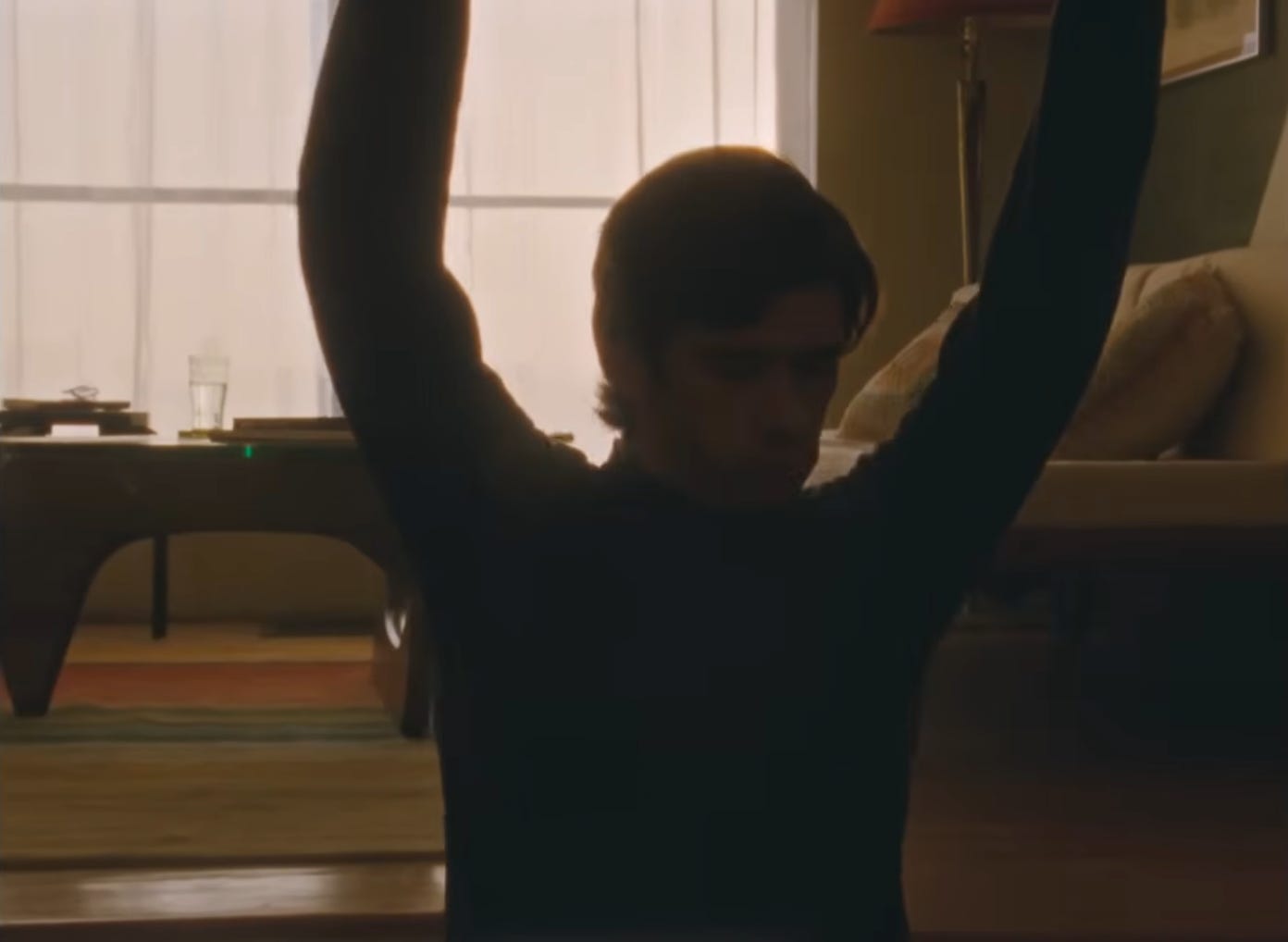
Dance on film is one of my favorite things. There’s an immediacy and directness in the marriage of the two forms that cuts through the artificiality of the choreography and that shrinks the distance to the viewer created by the lens.
I say this now as someone who would fast-forward through the ballet sections of old Hollywood musicals on VHS as a child because they bored me. Gene Kelly’s indulgences, like the extended dances of Singin’ in the Rain and An American in Paris, thrill me now instead. If I somehow were able to tell 10-year-old me that 45-year-old me recently enjoyed a movie that is basically all Gene Kelly ballet sequences — Invitation to the Dance (1956) — he would wonder what had happened to my brain. Maybe this is what getting old is like.
But that’s not true. My infatuation with dance on film developed during my time as an NYU student and after — you know that annoying time in a young cinephile’s life where they think every thought they have is the hottest and most prescient and most correct take. I was so annoying that once I gave up Hollywood movies for Lent — despite not being Catholic. (It led to me missing out on a group hang at the movies with a fellow student who was clearly flirting with me. Alas, they were going to see The Mexican with Julia Roberts and Brad Pitt, and I had taken an arbitrary vow. I have never seen that movie or that young woman since.)
I remember formulating a theory about how the best movies “danced.” This isn’t even literal — the best movies don’t need to include dancing — but in the same way that some music seems tuned to thoughtful appreciation or to zoning out or to mindless fun, movies seemed tuned that way to me too. And there’s a certain transcendence to the music that makes you dance — and the movies were capable of reaching that transcendent plane when they “danced” too.
I picked up on it in the musicality and choreography of Hong Kong action movies. I found it in the form-defining and -shattering early films of the avant-garde that NYU and my friend Zac and trips to Kim’s Video were all feeding me. John Woo danced. Kenneth Anger danced. Maya Deren danced.
Deren’s film of Chao-Li Chi enacting a series of martial arts exercises from the Wudangquan discipline, entitled Meditation on Violence, totally entranced me and became one of my all-time favorites at this time. (Because of copyright claims, there are no complete versions of the 19-minute short with its original soundtrack on Youtube, but below is a clip.)
I was going more on gut instinct with this notion of “dancing,” and I’ve never bothered to codify it into a formula or fleshed-out manifesto or something. I just picked up on this energy in many of the movies I loved, and I wanted to make sure I included that in any movies I made. How very “twenty-year-old dude” of me.
I realize now that my music video for Thomas Patrick Maguire’s “Waste of a Girl” owes more than a little to Maya Deren, though I’m not sure how conscious I was of this at the time.
Something that got me thinking about dance and film again is Ira Sachs’s wonderfully intimate, talky, sensuous, and stylish Peter Hujar’s Day. Ben Whishaw, who was also excellent in Sachs’s recent film Passages, plays queer New York photographer Peter Hujar. Rebecca Hall, who has previously portrayed Christine Chubbuck, Elizabeth Holloway Marston, and a lady who knows stuff about Godzilla, plays writer Linda Rosenkrantz. Linda invites her friend Peter to talk about his day for a potential book project, and writer-director Sachs envisions the interview as an all-day affair in which two creative people connect.
There’s a striking moment where Peter goes through Linda’s records and puts on a rockabilly 45, “Hold Me Tight” by Tennessee Jim.
This inspires them to take a break from talking and to just surrender to the rhythm of the record. They loosely dance around Linda’s dining room. Somewhat together and somewhat on their own while in each other’s presence. It’s a striking interlude that feels both real and like an all-caps MOVIE MOMENT.
In an interview with Hammer to Nail, Ira Sachs talks about conceiving the sequence as a release for the audience. “I needed to find ways to let the audience off the hook and also to experience the actors without words in certain kinds of movement or silence, or in this case, dance,” Sachs says. He talks about wanting to find a choreographer for the scene, but ultimately not doing that. “What you’re seeing is Ben and Rebecca just enjoying the song. It’s a record of that as well.”
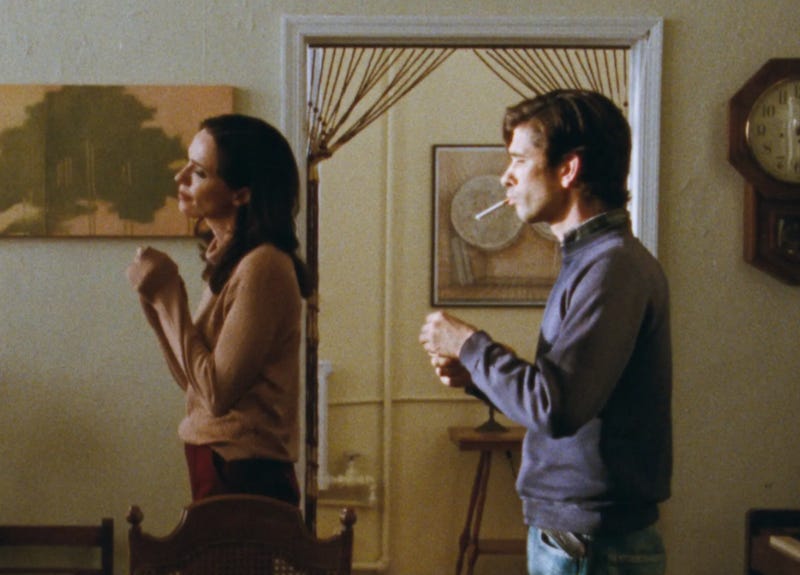
There are no good videos of this sequence online yet, which makes me almost want to hold off on posting this piece until after the flick appears on the Criterion Channel on Jaunary 27th. ’Cause I’m calling it now. Once more people see this scene, it will be all over social media faster than Leo DiCaprio can get his pointing finger ready to waggle at the screen he’s watching.
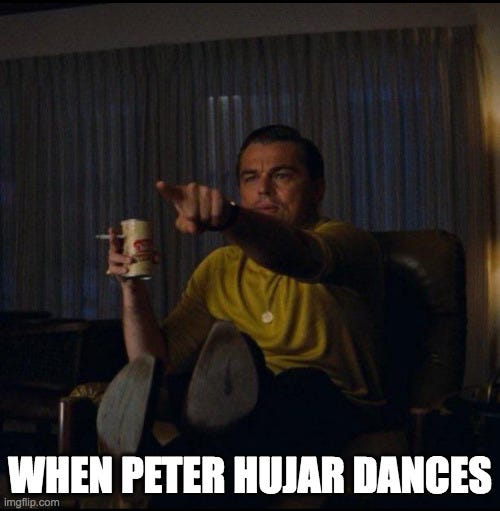
Eh… I will proceed without the Criterion Channel to refer to. So no moment-by-moment breakdown of this particular scene. Allow me to reflect instead about the other moments of isolated dancing in non-musical films that this “Hold Me Tight” moment made me mentally flash to.
I can’t be authoritative or definitive. I don’t have the time (or stamina) for that right now. For example, the ‘00s are littered with one-off musical numbers in big mainstream comedies, like The 40-Year-Old Virgin, Napoleon Dynamite, and The Love Guru. (500) Days of Summer put its own Fox Searchlight twee spin on the practice and basically paved the way for the OK-ness of La La Land. (What do you have against La La Land? You may ask. Nothing, it’s fine. But if I want to watch a Jacques Demy movie, I’ll just go for Demy’s pastiche The Young Girls of Rochefort rather than La La Land’s pastiche of the pastiche).
Around the same time, my former employers, Troma, rewrote their humanoid-chicken-zombie comedy Poultrygeist: Night of the Chicken Dead into an absurdist musical because Takashi Miike’s Happiness of the Katakuris seemingly opened the door to wacky musical numbers as the new in-thing for outlandish murder stories.
But as I said, I’m not being authoritative here. There’s probably a whole feature to be written about the desire of postmodern Jewish comedy directors like Mel Brooks and the Coen brothers to return to the outlandish glamor of Busby Berkeley’s giant production numbers.
But I’m not writing that piece. I am not being authoritative or definitive.
I am not writing about how John Travolta has danced in roughly a half-dozen non-musical films in the half-century since Saturday Night Fever. I’m not even pasting in those clips. (You’ve got Google!)
So what piece am I writing? Uh...
I know I call out art films in the headline, but—okay—I do want to take a brief moment to talk about a few ‘80s Hollywood movies that genuinely flickered through my brain when I saw Ben Whishaw let loose and bust a move to “Hold Me Tight.”
Even though Whishaw is so good at that British actor thing of physically embodying Hujar as an art creature of New York’s East Village in the ‘70s—the sleepy attitude, the cool cigarette-smoking, the semi-monotone speaking voice—his dancing immediately made me think of young Tom Cruise in Risky Business. Cruise’s mixture of cutting loose and self-consciously trying to look cool is there in Whishaw’s movements. The idea that dance can be freedom but also, at the same time, a come-on: it’s there in Cruise’s scene and in Peter Hujar’s Day.
The Gen X staple The Breakfast Club also features one extended sequence of dancing that shares thematic DNA with the “Hold Me Tight” scene. Emilio Estevez’s jock character reacts to smoking marijuana by going totally aggro. He executes hectic high-school-gymanstics moves in the school library and proceeds to punch-dance like he needs to punish the air as retribution for his poorly sublimated anxiety and repressed anger. To a much lesser extent, there is that aggro edge to Whishaw’s movements in his dance scene. Whishaw raises his arms at one point: a move that could be ecstatic but instead reads as mock-tough if not totally aggressive.
Meanwhile, Anthony Michael Hall, as the nerd character, finds a way to broadcast an upbeat pop song from the high school radio station inside the library. This inspires the other kids sharing detention in the library to dance along. The marijuana greased the wheels, and the music sealed the deal. Much like the dance moment in Peter Hujar’s Day, there are brief intersections between the characters here but The Breakfast Club sequence is essentially a collection of dance solos. These are discrete personal expressions that nonetheless bond the characters by the act of dancing to the same song.
One of the most famous dance scenes in art cinema is ironically about the disconnection between characters, despite the fact that their dance moves are synchronized. Jean-Luc Godard’s 1964 film Band of Outsiders (Bande à part) is possibly best remembered for the scene where the members of the film’s central love triangle all take part in the line dance known as the Madison.
On screen, the characters look playful and happy. Methodically, Godard drops out the music the trio dance to and inserts his own omniscient voice-over narration about the lurking thoughts and doubts of the characters as they dance. Do their actions become mechanical because this omnipotent voice with a signature lisp is telling us their minds and hearts are not on the dance? Rather than the act of dancing freeing these characters, they become trapped. Unsurprisingly, the two men peel off and stop before Odile, the sweet and somewhat unwitting femme fatale played by Anna Karina.
Hal Hartley repurposed this iconic image in his 1992 film Simple Men. Set to Sonic Youth’s “Kool Thing,” Hartley’s dance scene is kicked off (pun intended) by Martin Donovan as a fed-up blue collar guy who parks his pick-up truck, then awkwardly and extravagantly throws his cap to the ground and kicks it, shouting climactically, “I can’t stand the quiet!”
Inside a nearby bar, Donovan is next glimpsed watching Elina Löwensohn enact her own offbeat choreography to the blaring Sonic Youth track. She pulls down her elbow repeatedly, like she’s reverse-punching the air, or alternatively going, “Yes! Yes! Yes! Yes! Yes! Yes!,” after booby-trapping the bad guy in a ‘90s kids movie. Then she opens her arms and side-steps, as though swimming laterally in the air. Bill Sage, as one of two outlaw brothers hiding out in the small town where this bar is located, slowly starts to follow Löwensohn’s moves before Donovan ultimately joins in to form a trio.
Meanwhile, Robert John Burke and Karen Sillas sway and side-step nearby in a romantic-overture sort of way. Donovan starts eyeing that pair suspiciously but continues his choreography with Sage and Löwensohn until the song’s end.
For viewers unfamiliar with Hartley, his style is often pegged as deadpan and static. His dialogue is highly stylized but delivered with a flat affect—a bit like current-era Wes Anderson. The tracking camera and loud music is a stylistic jolt that shakes up the film and the characters.
Hartley memorably used a different dance trio in his earlier mini-feature Surviving Desire. Martin Donovan is there again, this time as a college professor who has fallen (perhaps foolishly) head over heels for one of his students. As a reaction to his feelings, Donovan wanders down a back alley with a pep in his step that jauntily turns into full-on choreography. (There’s even a little punch-dancing.) Out of nowhere, he is bookended by two strangers who seem to know his steps.
There’s a stiffness to the movements that feels like an intended parody of Hollywood musical choreography and is more in line with the mannered nature of Hartley’s typical filmmaking. Nonetheless, the effect is still one of exaltation. The trio even throw their arms into the air at one point, expressing the ecstasy that neither Emilio Estevez nor Ben Whishaw can seem to achieve. The sequence ends with Donovan miming the digging of a grave and then posing like the crucified Jesus. One presumes this is a final visual joke for viewers raised Catholic. Which again, I was not. But I still like the sequence.
The Surviving Desire scene is more of a surreal and possibly metaphorical aside than the Simple Men dance, which does make it closer in some ways to the “WTF/Random!” one-off musical scenes in those previously cited mainstream comedies. However, one of the best “random” dances in an ‘00s film is the work of one of world cinema’s great iconoclasts (and weirdos).
The “His soul is still dancing” scene from Werner Herzog’s Bad Lieutenant: Port of Call—New Orleans is the kind of thing that could be explained story-logic-wise by the pervasive drug use of Nicolas Cage’s titular bad lieutenant. But really, it just feels like Cage and Herzog brainstormed what’s the most fun weird shit they could put onscreen. Full confession: I mostly fast-forwarded through Bad Lieutenant 2 when it debuted on DVD, so I don’t have a good sense of the plot besides the title, and I’ve only ever revisited this scene on YouTube.
Basically, it looks like Cage sets up a guy to be killed by a rival gang during a face-to-face meeting and then tells his compatriots to shoot the dead man again because “His soul is still dancing.” The camera pans, and we discover a breakdancer dressed like the dead man, going nuts. Meanwhile, harmonica icon Sonny Terry’s “Old Lost John” wails away on the soundtrack (much like it did when Herzog used this song in 1977’s Stroszek). The dancing, counterpointed by Cage’s beatific grin, as he sees what presumably only he (and we) can see, is jaw-droppingly strange and beautiful.
And if we’re talking about beautiful, strange weirdos, we must be talking about French treasure Denis Lavant. His unusual, deeply creased and lumpy face is complimented by an animalistic athleticism that has served him well in a bunch of odd dance scenes. However, I’m just going to stick to my two favorites.
First is the uniquely moving mime-dance-run that Lavant performs in frequent collaborator Leos Carax’s Mauvais Sang (Bad Blood) to the accompaniment of David Bowie’s “Modern Love.” Lavant’s character is essentially babysitting Juliette Binoche, who is his gangster boss’s girlfriend and who he has fallen madly in love with. In a sudden burst of anguish and ecstasy, Lavant takes off running from his post, as “Modern Love” starts on a nearby radio and quickly overpowers the soundtrack.
The camera tracks his entire journey, with the background becoming a zoetrope-like onslaught of quickly glimpsed lines and geometric shapes in black, white, and red. Meanwhile, Lavant bounces, spins, cartwheels, collides, and careens. Seemingly, he’s never been more overwhelmed with emotion in all his life.
Is it mildly disappointing to compare Lavant’s ecstatic, Bowie-fueled journey through nighttime Paris streets in Mauvais Sang to Frances Ha’s daytime Manhattan approximation? No comment.
The other Lavant clip is frankly a kind of spoiler. Use your judgment, I guess. It is the final moments of Claire Denis’s reimagining of Herman Melville’s Billy Budd, 1999’s Beau Travail. As in the Mauvais Sang clip, Lavant’s character has been keeping a lot of secrets and emotions repressed. The final desperate dance we see Lavant perform is wild, athletic, flailing, awkward, brutal, heartbreaking, and sure, a little funny in its oddness.
In many ways, these scenes I’ve highlighted stand out not simply because they diverge stylistically from the films that contain them. Certainly, that makes them memorable. Yet, if the sequences had nothing to express about the greater films, I doubt they would have gained resonance over time and, in some cases, become iconic. The dance in these scenes manages to communicate ideas and emotions with eloquence that sometimes fails even the most deftly crafted language.
I could go on, and maybe I will. The nice thing about being non-definitive and non-authoritative is that I can revisit the topic of dance on film (and paste more clips!). After all, I have more bookmarked Channing Tatum videos that probably need analysis in this Substack.
So... to be continued?